Translate Us Translation on iPhone
Translate a Handwritten Postcard on iPhone: Read the Words, Keep the Gaps
Short answer: To translate a handwritten postcard from an iPhone photo, first make a faithful transcript of the readable words. Compare unclear letter shapes with the same writer’s other letters, mark unresolved words [illegible], then translate the checked text as a complete message.
Read a handwritten postcard from an iPhone photo with a faithful transcript, complete Spanish-English example and a clear way to handle illegible words.

Published by Clara Publisher
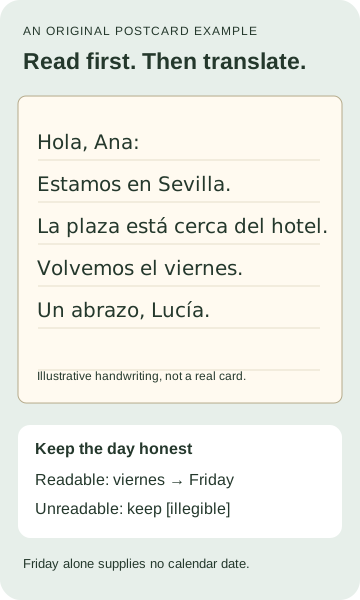
To translate a handwritten postcard from an iPhone photo, first make a faithful transcript of the readable words. Compare unclear letter shapes with the same writer’s other letters, mark unresolved words [illegible], then translate the checked text as a complete message.
You do not need to guess every word to get a useful reading. Keep the clear parts, show exactly where the uncertainty remains and ask the sender about that specific gap. The complete example below demonstrates both a readable card and an unreadable-day branch.
Spanish → English · Illustrative workflow
Read the complete postcard
Original educational example, not captured app output or a device test.
-
Illustrative starting information
Spanish input
Hola, Ana: Estamos en Sevilla. La plaza está cerca del hotel. Volvemos el viernes. Un abrazo, Lucía.
-
Completed illustrative record
English translation
Hi, Ana: We are in Seville. The square is near the hotel. We return on Friday. A hug, Lucía.
-
Check before relying on it
Friday has no calendar date here. Keep unreadable words marked instead of guessing.
Read one complete postcard before filling any gaps
Imagine Ana in the United States receiving a postcard from Lucía in Spain. The original handwritten-style illustration on this page was made for this example. It is not a photograph of a real card or a handwriting-recognition result.
The complete Spanish message and its English rendering appear below. The card says Friday, but supplies no calendar date. Keep that limit: you cannot infer a particular Friday from the text alone.
Example
- Complete Spanish input
- Hola, Ana: Estamos en Sevilla. La plaza está cerca del hotel. Volvemos el viernes. Un abrazo, Lucía.
- Complete English rendering
- Hi, Ana: We are in Seville. The square is near the hotel. We return on Friday. A hug, Lucía.
- Date check
- Friday is named; a calendar date is not supplied.
- Name check
- Ana and Lucía stay as written. Sevilla is rendered as the English place name Seville.
Keep the photograph and make a faithful transcript
Begin with the clearest photograph you have. Keep the full message, greeting and signature visible; a separate close view can help inspect a small word. Avoid glare, deep shadows and a crop that removes the end of a line. Enlarging a blurred stroke cannot restore information that the image never captured.
Transcribe the readable words before asking what they mean. Preserve names, spelling, punctuation and any stated date or number. Do not silently correct an unfamiliar name into a common word. Keep uncertain material visible in the transcript.
- Keep the complete postcard image as your reference, including the greeting and signature.
- Read one line at a time and write down only letters and words that the image supports.
- Compare an unclear letter with repeated examples written by the same person elsewhere on the card. Use the full word and neighboring words as context, without treating context as proof.
- Mark a word you still cannot read as [illegible]. Keep its position in the sentence.
- Translate the checked transcript as a complete message. Preserve the uncertainty marker, then ask the sender or another reader about the exact missing word.
Use repeated letters without inventing a word
Handwriting can make different letters look similar. Compare the writer’s repeated shapes, including where a stroke starts or finishes and how a letter joins the next one. A guess that fits the travel story is still a guess unless the strokes or the sender confirm it.
In our example, the lowercase v inside Volvemos gives you a same-writer shape to compare with the start of viernes. The repeated e letters in Sevilla, cerca and hotel offer additional comparisons. These clues help you inspect the image; they do not prove a blurred word must be viernes.
The illustration is intentionally readable so you can compare every line. On your own damaged or unclear card, use the uncertainty branch below instead of copying the answer from this example.
Finish the readable message even when one word is missing
Suppose the day in Volvemos el viernes. is unreadable in your photograph. Preserve the rest of the message and write Volvemos el [illegible]. The useful English result is We return on [illegible]. Do not substitute Friday unless the source becomes readable or the sender confirms it.
You can still understand the greeting, location and relationship between the square and the hotel. Keep those completed parts and ask a focused question about the missing day. The following Spanish question addresses Lucía and her traveling companions in Spain; it is not a guessed reconstruction of the missing handwriting.
Example
- Uncertain source line
- Volvemos el [illegible].
- Honest English result
- We return on [illegible].
- Clarification to send
- ¿Qué día volvéis? No puedo leer esa palabra.
- Complete English meaning
- What day are you returning? I can’t read that word.
- After a genuine answer
- Replace the marker with the confirmed word and keep a note that the sender supplied it, rather than treating it as a successful visual reading.
Translate the transcript and compare the finished meaning
Use the complete checked transcript for translation, keeping sentence boundaries and the signature. Read the finished English against the source line by line. Check who is traveling, where they are, what the location description refers to and which day is stated.
For this card, cerca del hotel means near the hotel. It describes the square, not Ana’s home. Volvemos means we return; do not turn it into a statement that Ana is returning. Neither the hotel name nor the return date is supplied.
Translate Us offers text translation for iPhone. A manually checked transcript gives you text to bring to another translation task. This approach does not depend on the app recognizing handwriting from a photo. Keep the original photograph alongside the text so unclear words remain traceable.
Reading record
Keep the complete worked record
An illustrative record you can use without installing an app.
Hola, Ana:
Estamos en Sevilla.
La plaza está cerca del hotel.
Volvemos el viernes.
Un abrazo, Lucía.

Hi, Ana:
We are in Seville.
The square is near the hotel.
We return on Friday.
A hug, Lucía.

Check: Friday has no calendar date here. Keep unreadable words marked instead of guessing.
Quick check
Before you translate
- Keep the starting information.
- Follow the matching branch.
- Compare the complete result.
- Leave unresolved details explicit.
FAQ
Frequently asked questions
Can I rely on photo translation for handwriting?
A fluent result does not prove that handwriting was read correctly. Compare the proposed source text with the photo. This guide uses manual transcription and does not claim Translate Us handwriting recognition.
What should I do with a word I cannot read?
Put [illegible] in its place, translate the remaining readable text and ask the sender about that exact word. Preserve the marker until the image or a reliable clarification resolves it.
Should I correct spelling before translating?
Keep a faithful original transcript first, including names and unusual spelling. If you prepare a corrected version, keep it separately and label what you changed; do not silently replace the source.
Does viernes tell me the exact return date?
It means Friday, but this example gives no calendar date. Ask which Friday if the date matters. Do not infer a date from an assumed delivery time.
How does Translate Us fit this method?
Its listed text translation feature is relevant once you have a checked transcript. Keep the photo as your reference and compare the result with the source; the method does not require handwriting OCR.
Sources
Useful links
Take it with you
Bring the checked postcard text to Translate Us
Use Translate Us text translation for the next message you have transcribed. Keep the original photo and any [illegible] markers beside the result so a smooth translation does not hide a missing word. Explore Translate Us on the App Store.
Explore Translate Us