Translate Us iPhone Translation Checks
Translate Long Text on iPhone Without Losing Paragraph Context
Short answer: Keep the full original, number coherent units, track references between them and check the assembled translation. Separate inputs do not prove that an app remembers earlier context.
A manual numbered-paragraph workflow with a full worked passage, continuity record and finished Spanish version, without invented app limits or document features.

Published by Clara Publisher
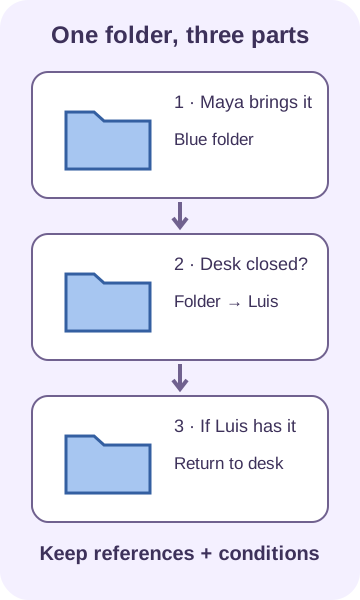
To translate a longer passage in sections, preserve the full original and number the parts before separating them. Keep related sentences together, record what names and pronouns refer to, then reassemble the results in the original order and check the joins. Do not assume a translator remembers a previous input.
The complete example below follows a blue folder through three paragraphs of a US neighborhood volunteer message. The second paragraph depends on the first, and the third depends on the handoff in the second. That makes continuity a checkable task rather than a vague instruction to keep context.
English → Spanish · Illustrative workflow
Keep paragraph 2 connected to paragraph 1
Constructed editorial input/output, not captured app output, automatic context memory or a document-upload demonstration.
-
Second unit from the preserved original
English input
She will leave it beside the sign-in sheet, not in the storage room. If the front desk is closed, Maya will give the folder to Luis instead. He will keep it until the desk opens. The sign-in sheet should stay at the desk; it is not part of the handoff.
-
Illustrative Spanish for unit2
Spanish translation
Dejará la carpeta junto a la hoja de registro, no en el almacén. Si la recepción está cerrada, Maya le entregará la carpeta a Luis en vez de dejarla allí. Él la guardará hasta que abra la recepción. La hoja de registro debe quedarse en la recepción; no forma parte de la entrega.
-
Check the carried references
She=Maya; it=blue folder; He=Luis. Handoff to Luis only if the front desk is closed. The sign-in sheet stays at the desk.
The whole input and a finished illustrative output
This is a constructed English-to-Spanish message for an illustrative Portland community open house. It is not a real event notice or captured app output. The names, objects and conditional instructions are the facts to preserve. There is no upload, automatic glossary or app-memory claim.
Example
- Complete English input
- Our neighborhood group in Portland is preparing a welcome table for a community open house. Maya will bring the blue folder to the front desk before the doors open. The folder contains the volunteer schedule and a list of the activities. Keep the schedule with the folder so the next volunteer can find it. She will leave it beside the sign-in sheet, not in the storage room. If the front desk is closed, Maya will give the folder to Luis instead. He will keep it until the desk opens. The sign-in sheet should stay at the desk; it is not part of the handoff. If Luis received the folder, he will return it there after the desk opens. Please leave the blue cover on it. The activities list may be updated during the afternoon, but the volunteer schedule should remain with the folder. Anyone taking over the welcome table can ask Maya which version of the list is current.
- Finished illustrative Spanish passage
- Nuestro grupo vecinal en Portland está preparando una mesa de bienvenida para una jornada de puertas abiertas de la comunidad. Maya llevará la carpeta azul a la recepción antes de que se abran las puertas. La carpeta contiene el horario de los voluntarios y una lista de las actividades. Mantén el horario con la carpeta para que el siguiente voluntario pueda encontrarlo. Dejará la carpeta junto a la hoja de registro, no en el almacén. Si la recepción está cerrada, Maya le entregará la carpeta a Luis en vez de dejarla allí. Él la guardará hasta que abra la recepción. La hoja de registro debe quedarse en la recepción; no forma parte de la entrega. Si Luis recibió la carpeta, la devolverá allí cuando abra la recepción. Por favor, deja puesta la cubierta azul. La lista de actividades puede actualizarse durante la tarde, pero el horario de los voluntarios debe permanecer con la carpeta. Quien se haga cargo de la mesa de bienvenida puede preguntarle a Maya qué versión de la lista está vigente.
- Chunk 2 input
- She will leave it beside the sign-in sheet, not in the storage room. If the front desk is closed, Maya will give the folder to Luis instead. He will keep it until the desk opens. The sign-in sheet should stay at the desk; it is not part of the handoff.
- Chunk 2 illustrative output
- Dejará la carpeta junto a la hoja de registro, no en el almacén. Si la recepción está cerrada, Maya le entregará la carpeta a Luis en vez de dejarla allí. Él la guardará hasta que abra la recepción. La hoja de registro debe quedarse en la recepción; no forma parte de la entrega.
- Completed continuity record
- She in paragraph 2 refers to Maya. It refers to the blue folder. He refers to Luis. There in paragraph3 refers to the front desk. The sign-in sheet stays at the desk and is not handed over.
- Conditional branch
- The handoff to Luis applies if the front desk is closed. The text does not say it is always closed.
Choose boundaries by meaning, not an invented character limit
Start with the existing paragraphs as working units. A paragraph commonly develops related ideas, but a boundary is not proof that every reference is self-contained. In this example, the opening She and it in the second part rely on the first part.
Read the sentence before and after each proposed boundary. Keep a condition with the action it controls and keep a list with its heading. If a paragraph is too large for the tool you are using, subdivide at complete sentences and retain the same reference record. No universal character allowance is established here.
A screenshot or a shortened extract is not a replacement for preserving the whole text. If you omit a necessary sentence, a later result cannot recover that missing source information merely by sounding fluent.
Use a numbered record on your iPhone
A note or document you already use can hold the full source and the numbered results. This describes an editorial organization method, not particular app controls. Use complete text inputs within the tool’s actually available capability; do not infer a full-document upload feature from ordinary text translation.
- Save the untouched full original and label its units 1, 2 and 3 in a separate working record. Keep the labels out of the message unless they belong there.
- For each unit, write its names, terms and references. Resolve She to Maya and it to the folder from the actual preceding paragraph, not from a guess.
- Translate one complete unit at a time in a supported text direction, retaining each exact result under the same unit number. Keep the context record available for review.
- Check the important terms and references across units. If the target language is unfamiliar, give the full original and all results to a reader of it rather than approving isolated sentences.
- Assemble the checked results 1, 2 and 3 in their original order. Confirm that none is missing or repeated and that headings and lists remain attached.
- Read across both joins. Verify the folder, names, location and conditional handoff, then retain any unresolved issue rather than filling it with a new fact.
Check what each join carries forward
At the first join, She continues Maya’s action and it continues the folder. The Spanish illustration names the folder in its opening sentence to make that object clear. That explicit noun preserves the supplied reference; it does not add a second folder.
At the second join, Luis returns the folder to the front desk after it opens only if he received it. A translation that sends the sign-in sheet to Luis would change the object. A version that hands the folder to Luis unconditionally would drop the if branch. Check those complete claims, not just matching names.
Keep important terms consistent by meaning rather than forcing identical forms mechanically. The illustrative Spanish uses carpeta for the folder and recepción for the front desk. Pronouns, inflection or wording can vary while the same object and location remain intact.
Example
- Unit 1 establishes
- Maya; one blue folder; front desk; volunteer schedule; activities list.
- Unit 2 carries forward
- Maya leaves the folder by the sign-in sheet. If the desk is closed, Luis receives the folder.
- Unit 3 resolves
- If Luis received the folder, he returns it to the front desk after it opens. The schedule remains with the folder.
- Decision on the assembled output
- All three units are present in order. The folder, people, condition and separate sign-in sheet retain their roles.
What to do when a part no longer makes sense
Return to the full original and the nearest relevant earlier sentence. If the source supplies the reference, add it to your separate note and have the target sentence checked in that context. Do not invent an antecedent because a pronoun needs one.
If the original itself is unclear, ask its author what the word refers to. For an editable message you wrote, you can prepare a separate clarified version with an explicit name, keeping the original saved. Do not silently rewrite somebody else’s quotation or present added context as their original words.
When correcting a result, check the complete assembled passage again at the affected joins. A corrected noun in one unit can leave an inconsistent pronoun elsewhere. The useful outcome is a passage whose continuity you can explain, with uncertainty still visible where evidence is missing.
Use text translation for the next supported passage
Translate Us lists text translation on iPhone. It is a relevant option for the next ordinary text unit, while your numbered source and continuity record remain separate. Check the current listing and the language task you need; this article does not establish an input limit or promise that earlier inputs are remembered.
For another passage, keep the same routine: whole original first, coherent units second, complete reassembly last. If a required input is not accepted or the result cannot be checked, retain the missing unit as unfinished instead of treating a partial translation as the complete document.
Continuity note
Keep the joins visible
A separate completed checking record, not a special translator command.
Unit order:1 →2 →3
References: She=Maya; it=blue folder; He=Luis; there=front desk
Condition: handoff to Luis only if the front desk is closed
Separate object: sign-in sheet stays at the desk
Completion check: all units present once, in order
Quick check
Before you translate
- Save the full original before splitting.
- Keep sentences, conditions and lists together.
- Record references from the real surrounding text.
- Reassemble every part once and inspect the joins.
FAQ
Frequently asked questions
How many characters can I paste into Translate Us?
An exact current input limit has not been established here. Do not infer one from this example or a general feature listing. The method organizes source and results; it does not promise that every passage length is accepted.
Will the app remember the previous paragraph?
That behavior has not been verified. Keep a separate continuity note and review references against the whole source instead of assuming memory across inputs.
Why not translate sentence by sentence every time?
An isolated sentence can depend on a name, term or condition elsewhere. Keep coherent units where possible and retain the surrounding context when smaller pieces are necessary.
Should I paste the context note into the message?
Do not assume an ordinary text translator treats appended notes as hidden instructions. Keep your source and editing notes separate; get the full target wording reviewed against the full original.
Does the Spanish passage prove app accuracy?
No. It is a constructed editorial translation, not an observed engine result or a benchmark. It shows a complete output whose references and conditional handoff can be compared with the supplied input.
Sources
Useful links
Take it with you
Keep each part of your next passage accounted for
Translate Us lists text translation on iPhone. For another supported text task, keep the whole original and numbered results beside your continuity note. Check the current listing for your needs, and review the assembled passage rather than relying on separate fluent fragments.
Explore Translate Us