Translate Us iPhone Translation Checks
Translate a Quoted Message on iPhone: Keep the Speaker and Date
Short answer: Keep the reporting sentence with the quote. Identify its speaker, action and original date before checking a translation; an undated tomorrow stays unresolved.
Keep a quoted I attached to its speaker and tomorrow attached to the original message date. Work through a complete example before translating or forwarding.

Published by Clara Publisher
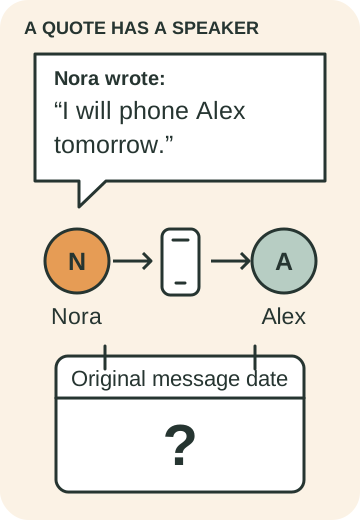
Keep the sentence that introduces the quote with the quoted words. In Nora wrote, “I will phone Alex tomorrow,” I means Nora, not the person reading or forwarding it. Tomorrow belongs to the quoted message’s time, not automatically to the current date on your iPhone.
The usable result is a short record: Nora is the caller, Alex is the person to be called, and the calendar day is unknown until the original message date is known. Keep those facts beside the wording you translate. That prevents a forwarded quote from becoming your own promise.
English → Spanish · Illustrative workflow
The quoted I still belongs to Nora
Constructed editorial translation and meaning check, not captured app output or an automatic speaker/date audit.
-
Keep the reporting frame
English input
Nora wrote, “I will phone Alex tomorrow.”
-
One illustrative Spanish wording
Spanish translation
Nora escribió: «Llamaré a Alex mañana».
-
Retain the unresolved date
Nora is the caller and Alex receives the call. The calendar date stays unknown until the original message date is known. The reader makes no new promise.
A complete example with one fact left unknown
This constructed example has no original message date. The Spanish wording below is an editorial illustration, not a captured translator result. The meaning record can be completed even when the calendar date cannot.
Example
- English source
- Nora wrote, “I will phone Alex tomorrow.”
- Illustrative Spanish wording
- Nora escribió: «Llamaré a Alex mañana».
- Completed meaning record
- Quoted speaker and intended caller: Nora. Person to be called: Alex. Calendar date: unknown. Commitment by the current reader: none established.
- Question that resolves the missing fact
- What date did Nora write the quoted message, in the relevant local calendar?
- Known-date branch
- If Nora confirms the quote was written on 28 October 2026, the intended day is 29 October 2026 in that original calendar. Do not use the date it was forwarded instead.
Keep the reporting frame, not just the words inside the marks
The reporting frame tells you whose words follow. Removing Nora wrote leaves I will phone Alex tomorrow, which a recipient could read as a new statement by the sender. Keep the name and the complete quote together when preparing text on your iPhone.
Direct and indirect reports can look different without changing the people involved. A direct quote can retain I; an indirect report can use Nora or an appropriate pronoun. Check who the action belongs to rather than demanding a word-for-word pronoun match.
If several people are quoted, make a separate record for each quoted speaker. Do not assume every I in a thread points to its most recent sender. When the message does not identify the speaker, ask who said it before attributing the promise.
Prepare and check the full passage
Start from the original message or a faithful copy, including its introduction. These are meaning checks you can do with any readable text; they do not depend on an app detecting quotations.
- Save the complete reporting sentence and quotation, keeping names and quotation boundaries.
- Write down who said the quoted words, what action was stated and who receives that action. In the example, Nora will phone Alex.
- Find the date of the original quoted statement. If it is missing, write date unknown and ask the sender for it. A forwarding timestamp alone does not supply the missing date.
- Prepare the complete passage for translation. Keep an explanatory note separate from the message rather than appending a command such as track the speaker to the quoted words.
- Compare the target wording against the speaker/action/date record. If you cannot read the target language, ask a reader of it to identify those same details before forwarding an important message.
When you know the date, make the reference explicit
For the known-date branch, an English report can say: On 28 October 2026, Nora wrote that Nora would phone Alex on 29 October 2026. Repeating the name here deliberately keeps the caller clear without adding a gendered pronoun. It reports Nora’s statement; it is not a promise by the reader.
Keep the original quote unchanged in your saved record. An explicit-date report is a separate paraphrase, not a silent edit to what Nora wrote. If the sender’s local date or the intended calendar is unclear around a time-zone boundary, clarify it before choosing the day.
Do not automatically replace every tomorrow with an absolute date or change every future tense. The reference may still be clear on the same day. The test is whether the intended day and person remain the same in the context where the report will be read.
Translate the complete next message
Translate Us lists text translation on iPhone. That makes a complete ordinary message a relevant input for your next translation, after you have identified the reporting frame and the facts that are actually known.
Keep the original and the meaning record while checking the result. A fluent sentence does not prove that its speaker and date survived. If a necessary fact remains missing, send the clarification question instead of forwarding a guessed commitment.
Checking note
Keep attribution beside the original
This is a completed editorial note, not an instruction to a translator or an app feature.
Quoted text: Nora wrote, “I will phone Alex tomorrow.”
Speaker/caller: Nora
Person to be called: Alex
Original quote date: unknown
Next action: ask for the original date before choosing a calendar day.
Quick check
Before you translate
- Preserve the quote and its introduction.
- Attach each first-person reference to its quoted speaker.
- Anchor relative dates to the original statement.
- Keep missing dates unknown until clarified.
FAQ
Frequently asked questions
Should I always replace I with the speaker’s name?
No. A direct quotation can keep I because its reporting frame identifies the speaker. An indirect report may use a name or pronoun. Preserve who owns the action; do not enforce a mechanical word swap.
Does tomorrow mean the day after I open the message?
Not automatically. In the quoted example it is relative to Nora’s original statement. Find that statement’s date, and clarify the relevant calendar if needed. The date you open or forward it does not replace the missing original date.
What can I send if the original date is missing?
Ask: What date did Nora write the quoted message, in the relevant local calendar? Keep the caller and recipient identified, but leave the calendar date unknown until the sender answers.
Are different quotation marks or a different tense proof of a wrong translation?
No. Languages and direct/indirect reports can use different punctuation and forms. Compare the actual speaker, action, recipient and time reference. If you cannot interpret the target construction, have those details checked by a reader of that language.
Sources
Useful links
Take it with you
Translate the whole message, with its speaker attached
For your next quoted message, keep the reporting sentence and quotation together. Translate Us offers text translation on iPhone. Check its current listing, then bring your complete passage to the next translation and compare the result with your speaker-and-date note.
Explore Translate Us