Translate Us Photo Translation on iPhone
Translate Comic Speech Bubbles on iPhone Without Losing the Speaker
Short answer: Keep the full panel, isolate one complete bubble, preserve its speaker and sequence, then compare the translated dialogue with the original.
A bubble-by-bubble reading method with an original comic, complete Spanish dialogue and English translation.

Published by Clara Publisher
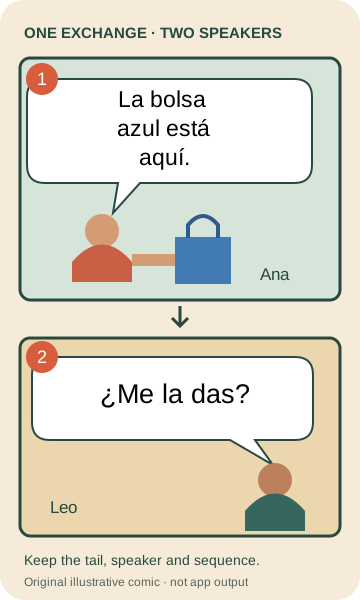
To translate a comic speech bubble from a photo on your iPhone, keep the whole panel as a reference and work on one complete bubble at a time. Record its place in the sequence and follow its tail to the speaker. Translate the sentence as a unit, then put the translated bubbles back in the same sequence.
A crop of words alone can lose the person speaking or the object they mean. Keep the original image alongside a numbered transcript; use the crop only to make the lettering easier to read.
Spanish → English · Illustrative workflow
Keep the speakers in order
Original comic example and editorial translation, not captured app output or OCR proof.
-
Original illustrated dialogue
Spanish input
Ana: La bolsa azul está aquí. Leo: ¿Me la das?
-
Finished illustrative English dialogue
English translation
Ana: The blue bag is here. Leo: Will you give it to me?
-
Check the reference
Leo asks for the blue bag. The request does not prove a handoff happened.
A complete Spanish-English comic example
Imagine a US reader looking at a Spanish comic in a language club. The original drawing on this page is made for this example. It uses two separate panels in a stated top-to-bottom sequence: Ana speaks first; Leo answers in the second panel. That sequence belongs to this example, not to every comic.
Ana is holding a blue bag. Her bubble reads La bolsa azul está aquí. Leo’s reply reads ¿Me la das? The complete English exchange is Ana: “The blue bag is here.” Leo: “Will you give it to me?” The pronoun it refers to the bag introduced in the first panel. These are editorial translations, not captured app results.
Example
- Panel 1, Ana, exact input
- La bolsa azul está aquí.
- Panel 1, complete English
- The blue bag is here.
- Panel 2, Leo, exact input
- ¿Me la das?
- Panel 2, complete English
- Will you give it to me?
- Finished ordered dialogue
- 1. Ana: The blue bag is here. 2. Leo: Will you give it to me?
- Context retained
- The blue bag is the object of Leo’s request. Ana and Leo are example character names.
- Complete source dialogue
- Ana: La bolsa azul está aquí. Leo: ¿Me la das?
- Complete English dialogue
- Ana: The blue bag is here. Leo: Will you give it to me?
Keep the full panel before narrowing the image
Save a reference that shows the entire bubble, its tail and the relevant drawing. A close crop can improve legibility, but it should not be your only copy. Include every line inside the bubble and the end punctuation. Do not crop the start or end of a sentence to fit a rectangle.
Use the clearest source available. For a photographed page, face it squarely and avoid glare or a shadow across the lettering. Enlarging a blurry image does not recover missing letters. If a character is unreadable, mark that spot rather than substituting a word that seems to fit.
- Keep the whole panel as the reference image. If the exchange crosses panels, keep the neighboring panel too.
- Number the bubbles in the comic’s established reading sequence. Use the edition’s reading instructions and page layout; do not infer the direction from the language alone.
- Follow each bubble’s tail and record the speaker. If the tail or speaker is obscured, label the speaker unknown.
- Make a separate close view of the complete bubble while retaining the full reference. Keep punctuation and all the lines.
Turn the lettering into one complete sentence
Read or transcribe the lines in their intended order inside that bubble. Line wrapping is usually a layout choice; do not translate every short line as an unrelated sentence. Preserve a genuine sentence break, question mark or interruption. Keep unclear characters marked in your transcript.
Photo translation can provide a first reading of visible words. Compare that reading with the lettering before treating it as a transcript. Decorative fonts, tiny punctuation, text behind artwork and vertical lettering need particular care. A fluent translation cannot tell you that the source was captured correctly.
For the first bubble in the example, three display lines, La bolsa / azul está / aquí., form the complete sentence La bolsa azul está aquí. The word azul describes the bag; separating it from bolsa would discard that relationship.
Example
- Visible lines, top to bottom
- La bolsa azul está aquí.
- Complete source sentence
- La bolsa azul está aquí.
- Completed meaning
- The blue bag is here.
- Keep out of this transcript
- Leo’s separate bubble and any caption outside Ana’s balloon.
Translate a bubble, then check the exchange
Choose the source language from the comic’s publication information and the language actually used in the bubble. Translate the whole sentence, keeping a neighboring bubble as context when it supplies a reference. Do not silently combine both speakers into one statement.
In the example, translating Leo’s reply alone leaves the object unstated in English. Ana’s preceding line supplies it: the blue bag. The final transcript keeps that connection without adding an invented action such as Ana handing it over. A request is not proof that the handoff happened.
Read the translated exchange in the recorded order. Check who is asking, what they are asking for and whether a negative, question or unfinished sentence survived. Preserve uncertainty if the artwork and words do not settle a reference.
- Record the exact source text under its bubble number and speaker.
- Translate the complete sentence, not each visual line separately.
- Use the adjacent dialogue to resolve references only when it actually identifies them.
- Write the translated sentence under the same number and speaker.
- Compare the ordered result with the full panel. Keep sound effects and narration in separate records.
When the order or a word is unclear
A bubble’s tail identifies its connection to a speaker; it does not always establish which bubble comes first. Overlapping balloons, interruptions and unusual panel layouts can be deliberate. If the edition or scene does not settle the sequence, retain both possible orders and say which reference remains unclear.
For unreadable lettering, return to a clearer page or ask someone who can read the script to check that exact crop. Keep the full panel available so they can see the context. Do not turn an uncertain source word into a confident finished translation.
Keep your work limited to material you have permission to use. The original example here is not a scan from a published comic. A translation worksheet for your own reading is different from republishing someone else’s artwork.
Bring the next bubble to Translate Us
Translate Us offers photo and text translation on iPhone. For another clear bubble, photo translation is a way to begin; a checked transcript also gives you a text version to translate. Keep the full panel and your speaker-number record beside the result.
The reading-order check remains yours. Do not expect a translation result to establish balloon order, recognize every decorative font or identify the speaker from the artwork. Check the language support relevant to your task before relying on a result.
Reading record
Keep the source and finished reading together
An illustrative reading record, not an app command.
Source: Ana: La bolsa azul está aquí.
Leo: ¿Me la das?
English: Ana: The blue bag is here.
Leo: Will you give it to me?
Check: Leo asks for the blue bag. The request does not prove a handoff happened.
Quick check
Before you translate
- Keep the complete original image.
- Preserve words, punctuation and numbers.
- Retain order and context.
- Resolve unclear source text before relying on the result.
FAQ
Frequently asked questions
Should I crop each bubble separately?
Keep the full panel first, then make a close view of one complete bubble. Preserve its number, speaker, tail and surrounding reference so the translated words do not lose their context.
Do all comics read left to right?
No. Use the edition’s established reading direction and panel sequence. The example here explicitly uses a top-to-bottom two-panel sequence; that is not a rule for every comic or language.
What if the words are arranged on several lines?
Rejoin layout lines into the complete source sentence, preserving actual punctuation and interruptions. Translate that sentence as a unit. Do not combine words from different balloons.
Can a translation tell me which character is speaking?
The words alone may not. Retain the bubble’s tail and the full panel, and label the speaker unknown when the image does not establish one.
Are these tested Translate Us OCR results?
No. The artwork and translations are original illustrative examples. The product listing supports photo and text translation, not a claim that this comic or its layout was recognized by the app.
Sources
Useful links
Take it with you
Translate the words, keep the comic context
Use Translate Us for photo or text translation of the next bubble you want to read. Keep your numbered panel reference beside the result so the speaker and sequence stay clear. View the app on the App Store.
Explore Translate Us