Translate Us iPhone Translation Checks
Translate a Mixed-Language Message on iPhone Without Changing Names
Short answer: Keep the whole original, identify the language of each passage from real context, translate the needed parts and check the complete result against names and quoted labels.
A complete mixed-language message and English rendering with a span record, exact-name check and a clarification path for unknown text.

Published by Clara Publisher
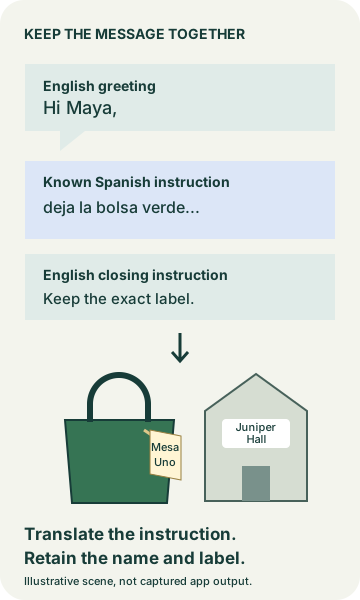
To translate a message that switches languages, save the whole original first. Identify which passages you actually know the language of, translate the parts that need translating, and put them back in the same order. Check names, quoted labels and references against the original before using the complete result.
Do not treat a person’s name or a short unfamiliar phrase as proof of a language. If a passage’s language or meaning is unresolved, keep it marked and ask the sender. A smooth sentence is not a reason to fill in missing information.
English and Spanish → English · Illustrative workflow
Reassemble the whole message with its names intact
Constructed known-language example, not captured app output or automatic language-detection proof.
-
Complete mixed-language input
English and Spanish input
Hi Maya, deja la bolsa verde en Juniper Hall. Please keep the label "Mesa Uno" on it.
-
Finished illustrative English message
English translation
Hi Maya, leave the green bag at Juniper Hall. Please keep the label "Mesa Uno" on it.
-
Compare the exact identifiers
Maya, Juniper Hall and the printed label Mesa Uno remain unchanged. It still refers to the green bag.
A complete message for a US community volunteer
Imagine a US neighborhood group sending an English-Spanish message to a volunteer. In this constructed example, the sender has confirmed that the middle instruction is Spanish, Juniper Hall is the venue’s proper name, and Mesa Uno is the exact wording on the bag’s label. Those facts are supplied context, not guesses from the spellings.
The finished English version retains the greeting and closing instruction. Only the Spanish instruction changes language. Mesa Uno stays as written because the recipient needs to match the physical label; an explanation of its meaning belongs in a separate note. This is an illustrative translation, not a captured app result.
Example
- Complete mixed input
- Hi Maya, deja la bolsa verde en Juniper Hall. Please keep the label "Mesa Uno" on it.
- Known Spanish passage
- deja la bolsa verde en Juniper Hall.
- English rendering of that passage
- leave the green bag at Juniper Hall.
- Finished English message
- Hi Maya, leave the green bag at Juniper Hall. Please keep the label "Mesa Uno" on it.
- Exact-name and label check
- Maya → Maya; Juniper Hall → Juniper Hall; "Mesa Uno" → "Mesa Uno".
- Reference check
- it refers to the green bag. Keep the label on that bag.
- What was supplied
- Spanish source passage, English target, venue-name status and exact-label status are known in this example.
Separate passages by meaning, not by every unfamiliar word
The opening Hi Maya is English plus a name. The middle instruction is Spanish and includes the proper name Juniper Hall. The closing sentence is English but contains the Spanish-looking label Mesa Uno. A passage can contain a name or borrowed term without becoming a new source-language passage.
Keep a complete phrase or sentence together. Here, deja la bolsa verde en Juniper Hall keeps the action, object, description and destination in one unit. Splitting at Juniper Hall would separate the destination from the instruction it belongs to.
In this sentence, deja is an instruction to leave something, la bolsa verde is the green bag, and en connects it to the named place. The final English wording uses at Juniper Hall. This applies the supplied context to this example; it is not a word-for-word rule for every use of dejar or en.
Example
- Span 1, retained
- Hi Maya,
- Span 2, translated
- deja la bolsa verde en Juniper Hall. → leave the green bag at Juniper Hall.
- Span 3, retained
- Please keep the label "Mesa Uno" on it.
- Do not translate as an identifier
- The exact printed label is Mesa Uno, even though its words can also have an ordinary-language meaning.
Make a complete result you can check
Use a separate working note for language choices and terms to retain. Keep that note outside the message itself so it does not accidentally become part of the text being translated. This is a manual reading method; no automatic language detection or term-locking feature is required.
- Save the exact whole message, including punctuation, quoted labels, names and the sentences around each language change.
- Choose the target language. Record the source language of each passage only when the sender or another reliable source establishes it; otherwise mark it unknown.
- Make a short list of names and exact identifiers that must remain unchanged. Confirm whether a quoted phrase is a label to match or ordinary prose to translate.
- Translate each known-language unit that needs a change, keeping its action, object, modifiers and destination together. Leave passages already in the target language in place.
- Reassemble every passage in the original order. Compare the full result with the original, checking that no greeting, condition, negative or closing instruction disappeared.
- Check names and labels character by character, then resolve references such as it from the full message. Ask for clarification rather than guessing any remaining gap.
Preserve a label without losing the explanation
For the example above, the useful final instruction still says the label Mesa Uno. Replacing that identifier with an English translation could make it harder to find the right object. If the recipient also needs the words explained, add a separate explanation rather than silently changing the identifier in the message.
Not every foreign phrase is a name or an identifier. The reason for retaining Mesa Uno here is the sender’s explicit description of it as the exact printed label. If a phrase’s status is uncertain, ask whether the wording must match a sign, document or object. Do not decide solely from capitalization or quotation marks.
Preserve numbers and units exactly when the source contains them. Convert or explain them separately only when the task calls for it, labeling that additional work. The example has no date, amount or unit to infer.
When the language or reference is still unknown
A completed reading can include a clearly stated unresolved part. Keep the exact original phrase in your working copy and ask which language it is and what it means in this message. Do not silently remove the phrase or choose a language because it resembles a familiar word.
If it could refer to more than one object, ask the sender to name the object. A translation tool cannot supply a missing real-world fact merely by producing grammatical wording. Before acting, resolve any gap that changes the instruction.
Example
- Starting information
- A mixed message contains an unfamiliar phrase, but its language and the object it refers to are not known.
- Finished reading status
- Incomplete: retain the exact phrase and mark its language and reference unresolved.
- Useful question to send
- Which language is this phrase in, and which object does it refer to?
- Next action
- Use the sender’s answer to update the source record, then check the whole message again.
Use the record alongside your next text translation
Translate Us lists text translation for iPhone. That can be a useful next step for another passage whose source language you know. Keep the complete original beside the result and use the same name-and-label check before relying on the wording.
The example here does not establish that an app detects several languages at once or preserves particular terms automatically. Check support for your needed language direction, and ask a reader of the target language when a meaning remains uncertain. Your completed message record is the basis for that check.
Message record
Keep one complete original and one complete result
A manual working record, not an app command or captured translation.
Original: Hi Maya, deja la bolsa verde en Juniper Hall. Please keep the label "Mesa Uno" on it.
Target: English
Known source passage: Spanish middle instruction
Names and label to retain: Maya; Juniper Hall; Mesa Uno
Completed result: Hi Maya, leave the green bag at Juniper Hall. Please keep the label "Mesa Uno" on it.
Quick check
Before you translate
- Confirm the language of each passage rather than guessing.
- Keep sentence-level context around names.
- Preserve exact names and physical labels.
- Reassemble and check the entire message.
FAQ
Frequently asked questions
Can I translate the whole mixed message as one language?
That assumes every passage has the same source language. Identify the passages from real context and check each one. This guide does not establish automatic mixed-language detection in any app.
Should names and labels always be translated?
No. Keep a proper name or an exact identifier when it needs to match the original. If its status is uncertain, ask the sender. Ordinary prose in another language still needs translation.
Why does Mesa Uno remain in the English example?
The sender identifies it as the exact text on the bag’s label. Retaining that text lets the reader match the label. Its explanation can be supplied separately without replacing the identifier.
What if I cannot identify one phrase’s language?
Preserve the exact phrase, mark it unresolved and ask the sender which language it is and what it means here. Do not use the message as a complete instruction while a consequential gap remains.
Is the example an actual Translate Us result?
No. It is a constructed English-Spanish example with an editorial English rendering. The official listing supports ordinary text translation, not this exact output or a tested mixed-language feature.
Sources
Useful links
Take it with you
Bring context to the next passage you translate
Translate Us lists text translation for iPhone. For another passage whose source language you know, keep the original message alongside the result and check names and quoted labels yourself. View Translate Us on the App Store for the translation task you need.
Explore Translate Us