Find Now · Device-finding guide
Find Lost Earbuds in a Parked Car Without Reaching into Seat Mechanisms
Search only after the car is parked and you can work clear of traffic. Start with the clothes and bag from the last handling event, then the seat surface and visible, freely reachable floor area. Use a light to look before reaching. Stop if the earbud is trapped near rails, wiring or moving parts, or if retrieval needs seat adjustment or dismantling. A Bluetooth clue cannot establish a safe path for your hand.

Published by Clara · Publisher
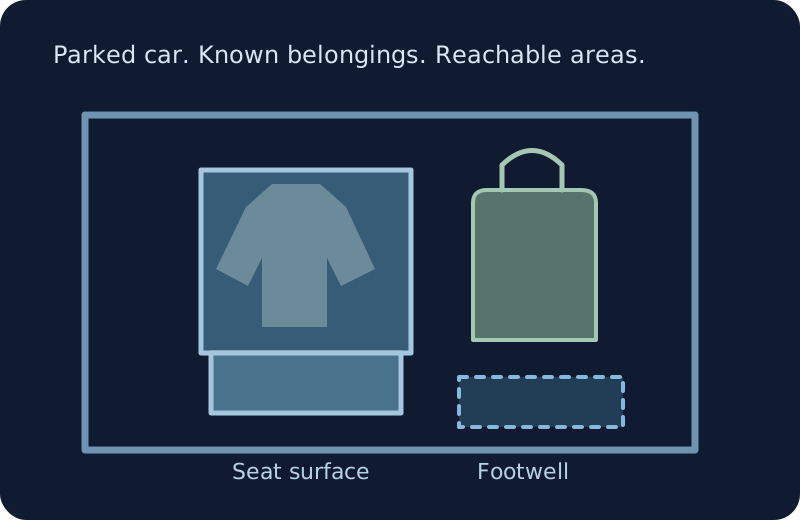
A narrow car-seat gap changes the search problem. You need to distinguish an accessible loose item from something hidden in a mechanism, not simply keep reaching toward a stronger signal.
This guide covers a parked-car visual and physical check. It gives no vehicle-specific adjustment procedure and no claim that a finder can see through every part of a car. Searching or watching feedback while driving is outside this workflow.
Completed example
Worked example: a missing right earbud in a Columbus driveway
Starting information
Your car is parked in your own driveway with the engine off. The right earbud slipped from your hand while you removed a hoodie in the front passenger seat. The hoodie and your backpack are now on that seat. The case and left earbud are already accounted for on the kitchen counter. With the passenger door open, the seat cushion and visible footwell can be checked without adjusting the seat. The narrow inner gap is dark; you cannot see the earbud there.
Useful outcome
Check the hoodie pockets and your backpack, then the cushion surface and visible footwell, marking each checked. Use a light to inspect the dark gap without pushing a hand or tool into it. If the earbud remains unseen or appears trapped beside a rail or wire, stop that retrieval attempt and use the car’s manufacturer/service guidance. Keep the right earbud unresolved; the kitchen case and left earbud do not need another search.
Illustrative bounded search plan, not a recovered earbud, vehicle repair, app result or proof of safe access in a specific car model.
Start with the car parked and the item defined
NHTSA describes activities that divert attention from driving as distractions. Do not run this search or follow phone feedback while the vehicle is moving. If the car is not in a suitable parked place, postpone the search.
Name the missing component and the last handling event. In the example, the right earbud is missing, while the case and left earbud are accounted for indoors. That keeps the search tied to the passenger-seat event instead of restarting the whole household search.
Check reachable areas before the dark gap
- Record the last handling seat and the clothes or bag present at that moment. Search your own pockets and bag on a clear surface. Keep found components together somewhere secure so they do not become new missing items.
- Inspect the seat cushion, seams visible from above and nearby loose belongings without adjusting the seat. Move only your own lightweight items that are plainly accessible. Record checked surfaces separately from places you have not seen.
- Look at the visible footwell and loose item edges with a light. Retrieve an item only if it is plainly accessible without entering a mechanism or putting your hand where you cannot see the path.
- Inspect a dark gap visually from an accessible position. If you cannot see the item or the approach is uncertain, mark the gap unresolved. Do not assume that a hand, hook or vacuum nozzle can safely follow a sound or signal.
- Stop if retrieval involves rails, wiring, connectors, trim removal, bolts or seat movement. Do not use a generic blog procedure to dismantle or operate the seat. Use the exact vehicle’s manufacturer information or qualified service help for the inaccessible item.
- Before any later trip, keep an unresolved object near driving controls as a separate concern that needs appropriate assessment. A stronger signal or a quick look is not proof that the vehicle’s controls and seat mechanisms are clear.
Looking into a gap is different from entering it
The diagram separates visible loose-item space from the seat’s mechanism area. It is a conceptual boundary, not a repair map. Actual rails, wiring and access differ between cars.
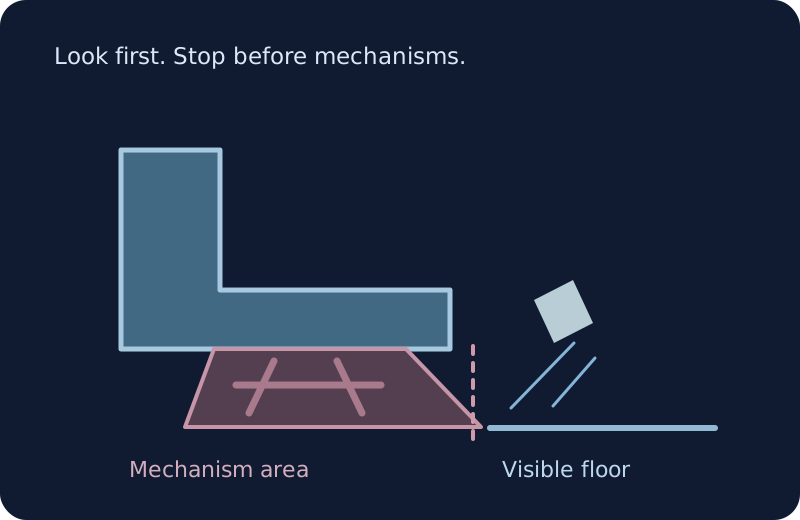
Why the stop point matters
Mazda’s front-seat guidance specifically warns about injury from moving parts and surrounding rail/frame areas when picking up dropped objects. That supports a conservative stop boundary; it is not permission to apply one model’s seat controls to another car.
If the item is lodged, leave it for the exact vehicle’s guidance or qualified service rather than trying seat-removal instructions, disconnecting wiring or forcing a tool through the gap. This page does not diagnose a mechanism or certify the car ready to drive.
A signal can prioritize a check, not prove safe access
Bluetooth SIG explains that equipment and surroundings affect radio range. A received signal near the passenger seat does not identify the precise gap, prove an object is reachable or distinguish a loose earbud from a trapped one.
Keep any existing observation beside the physical note: seat surface checked, floor checked, inner gap unresolved. Do not convert an unobserved target into a claim that the earbud left the car, or follow the strongest unfamiliar entry without a credible identity.
Where Find Now fits while the car stays parked
Find Now’s official listing names Bluetooth finding with signal-strength feedback. For your own detectable nearby earbud, that can be a clue to add while comparing accessible search areas.
The physical boundary still governs retrieval. Installing a finder does not establish a safe approach, move a trapped object or guarantee detection inside a car. If the next step is service for an inaccessible gap, an app download does not replace it.
Questions that come up next
Should I slide the seat to shake the earbud loose?
This guide does not recommend seat movement as a retrieval method. An object can be near moving parts, and the exact vehicle’s instructions matter. Stop the generic search at that boundary and use manufacturer/service guidance.
Can I push a hook or vacuum hose into a dark gap?
Do not use this guide to enter an unseen path with a hand or tool. Look first. If the object is not freely reachable outside mechanisms, leave the retrieval for the exact vehicle’s guidance or qualified help.
What if only the right earbud is missing?
Keep the left earbud and case accounted for separately, as in the example. Search from the right earbud’s own last handling event rather than assuming the case’s location resolves it.
Does a strong Bluetooth reading locate the exact seat gap?
No. Treat it as a local observation to compare with physical evidence. It establishes neither a precise gap nor safe access, and it must have a credible connection to your own item.
What if the earbud is visible but beside a rail or wire?
Visibility alone does not make retrieval safe. Stop before the mechanism area and use the exact vehicle’s manufacturer information or qualified service. Do not disconnect or dismantle parts from generic instructions.
For your next nearby search
Keep local feedback within a physical search boundary
While safely parked, consider Find Now’s Bluetooth signal-strength feedback for your own detectable nearby earbud. Use it only as a clue for accessible areas; it cannot certify a seat gap safe or replace help for a trapped item.
Explore Find Now