Find Now · Device-finding guide
Report Lost Headphones Without a Serial Number: Write a Useful Description
Write a description from details you know: the item and missing components, brand or model when certain, color, distinctive marks, and the last confirmed handling event. State that the serial number is unavailable instead of making one up. That gives you useful report text now. The receiving office still decides what information its process requires; a detailed description is not proof of ownership or a guarantee of acceptance.

Published by Clara · Publisher

The missing number should not turn every other detail into a blank. A blue fabric wrap, a chipped hinge or a known carrying case can help describe the physical item. Keep those observed details separate from a model name you only suspect.
This guide produces the description itself. Choosing which airport or airline office handles a loss is a separate task covered in the next reads. Nothing here submits a report or establishes that a recipient will accept an unknown serial number.
Completed example
Worked example: a Chicago-to-Phoenix traveler with no serial available
Starting information
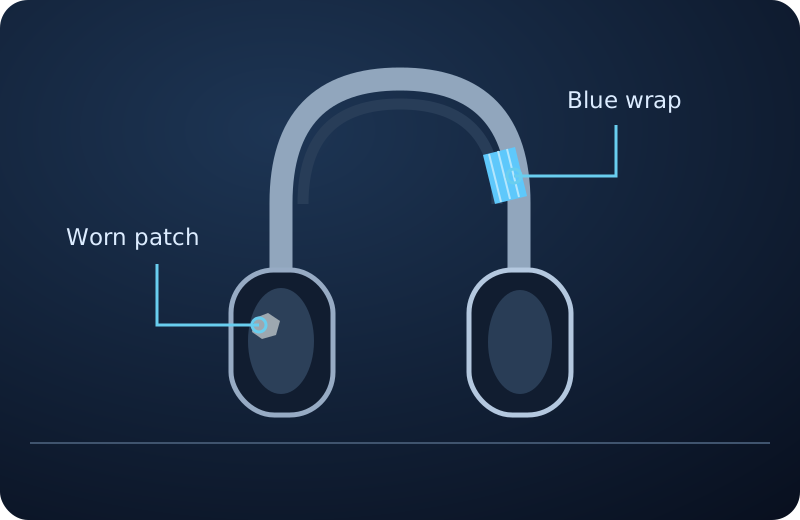
You last handled your black over-ear headphones in seat 18C on your November 4 flight from Chicago to Phoenix. Your itinerary contains the actual airline and flight number. You know the brand is Bose but are not sure of the model. A short blue fabric wrap is attached to the right side of the headband; the left ear cushion has a small worn patch. The headphones had no case with them. You have no serial number, receipt, box or item photo available.
Useful outcome
Description: Black Bose over-ear headphones, model unknown. Blue fabric wrap on the right side of the headband and a small worn patch on the left ear cushion. Headphones only, no case. Last confirmed in my hands in seat 18C on the November 4 Chicago-to-Phoenix flight; airline and flight number are available from my itinerary. Serial number unavailable. I do not have a receipt, box or item photo available. Please tell me what additional identifying information your process needs.
Illustrative completed description from supplied details, not an actual customer report, proof-of-ownership review or submitted claim.
Start with the physical item you are missing
Name the form of the object before its history: over-ear headphones, two earbuds with their case, a single left earbud, or an empty case. Those are different items to match. If an accessory was not with it, say so rather than describing a complete retail set.
Then separate certain identifiers from uncertain ones. In the example Bose is known and the model is not. Writing a guessed premium model would make the description less faithful, even if it sounded more complete.
Build the text in five passes
- Write the item type and exactly which pieces are missing. Include a case only if you know it was with the headphones. Do not copy a product bundle description from a store page.
- Add the brand and model you can support. Use model unknown when that is the honest state. A broad but true description is more useful than a precise invented one.
- Add visible distinctions and their positions: right side of headband, left cushion, one scratched cup or a particular attached wrap. Describe a mark you remember without turning it into a unique-identity guarantee.
- Add the last confirmed handling place and date. Include itinerary details you actually possess in the relevant report fields. Distinguish last held at seat 18C from a conclusion that the headphones must still be there.
- State the missing identifier directly: serial number unavailable. Add what supporting material you do or do not have. Keep this description as your draft; the recipient’s own process governs what else you must provide.
A physical detail needs a location
“Blue wrap” is more useful when its position is included. The example places it on the right of the headband and the worn patch on the left cushion. Neither detail becomes an ownership credential merely because it is distinctive.
What an actual report prompt asks for
American Airlines’ official Lost and Found page leads to a report asking for a detailed description with brand, color, size and distinguishing features. Its electronics example asks for a serial number or screen saver. The visible prompt supports preparing specific details; it does not prove that every missing-number entry will pass validation.
For that reporting route, start at the official aa.com site and find Lost and Found, then its linked lost-item report. For another recipient, use that recipient’s official reporting channel. Read its requirements rather than assuming a form works the same way.
If a form will not proceed without an identifier
Do not replace a missing serial number with a made-up sequence, another device’s number or a Bluetooth entry name. Keep your truthful description and use the recipient’s official help/contact route to ask how an unavailable identifier should be handled.
If you later find the real number in records you already have, retain the correction and follow the office’s method for updating the existing case. This article gives no claim-submission workaround and does not verify any specific form’s acceptance behavior.
Use the same description in a local search
The description also defines which physical item you are still looking for. If the headphones might be among your own nearby belongings, keep those marks beside any local observation rather than treating an unfamiliar radio label as a match.
Find Now is listed for Bluetooth finding with signal-strength feedback. That can be relevant when your own target is detectable nearby. It neither supplies the missing serial number nor turns a signal into proof for a lost-property office.
Questions that come up next
Can I guarantee a report will be accepted without the serial number?
No. You can prepare an honest useful description without that number, as the example shows. The office or reporting system decides its required information. Ask its official support route if the process blocks you.
Should I guess the model from a similar product photo?
Do not present a guess as fact. State the brand you know, model unknown, and the physical details you actually remember. A later verified model can be added as a correction.
Is a Bluetooth device name a substitute for the serial number?
No. Keep an observed name separate from the physical description and unavailable serial field. This guide establishes no one-to-one relationship between that label and a manufacturer identifier.
What if the headphones were inside a case?
Describe the headphones and the case only if both were missing together. Include their separate colors and marks when known. If the case is already at home, say headphones only instead of describing it as lost.
Does a detailed description prove I own a found item?
No. It gives the recipient matching information. Follow that office’s actual verification process; do not treat a mark, brand or submitted description as automatic ownership proof.
For your next nearby search
Carry the physical description into your nearby search
If those headphones may still be among your own nearby belongings, consider Find Now’s Bluetooth signal-strength feedback for a detectable target. Keep your physical identifying details beside the clue; the app does not generate a serial number or verify a lost-property claim.
Explore Find Now