Translate Us iPhone Translation Checks
Check a Word’s Meaning in Context on iPhone
Short answer: Save the sentence, identify the word’s job, compare dictionary senses and explain which context supports the choice. A fluent translation alone is not a definition.
Use a sentence and dictionary senses to distinguish meaning from a fluent translation, with a completed example and an uncertainty path.

Published by Clara Publisher
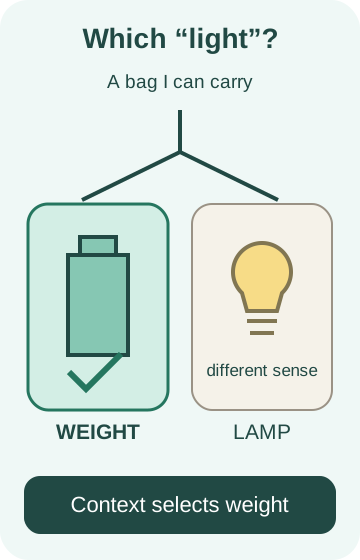
To check an unfamiliar word, keep the sentence around it and compare the relevant dictionary entries. Identify whether it is acting as a noun, adjective or another form; then choose a meaning that fits the actual sentence. A translated sentence can help you read a message, but it is not by itself a dictionary definition of each word.
For example, in This bag is light enough for me to carry, light describes the bag’s weight. The clue is the connection to carrying it. That is different from light as a lamp or illumination. The completed record below shows why the weight sense fits rather than asking you to trust a polished answer.
English · Illustrative dictionary workflow
Choose the meaning supported by this sentence
Constructed dictionary-backed explanation, not captured app output or a native control demonstration.
-
Word in its full context
English input
This bag is light enough for me to carry.
-
Completed dictionary-sense reading
Dictionary reading and meaning
light: low in weight in this sentence; an adjective describing the bag.
-
Keep the reason for the choice
The clue is enough for me to carry. A bare light would leave the sense unresolved.
A complete word check for a US traveler’s message
Imagine a US traveler discussing a bag with a friend who is learning English. The friend understands the message but wants to know what light means here. This is a constructed language example, not a captured dictionary result or a claim about airline baggage rules.
A dictionary separates uses of light, including illumination and an adjective meaning low in weight. The sentence selects the weight use: light describes bag, and enough for me to carry supplies the practical context. No weight in pounds, color or transport limit has been supplied.
Example
- Dictionary input
- This bag is light enough for me to carry.
- Word being checked
- light
- Part of speech in this sentence
- Adjective describing bag.
- Competing senses shown here
- Low in weight; illumination or a light source. These are examples of different uses, not an exhaustive entry.
- Context evidence
- enough for me to carry links the description to weight.
- Finished meaning
- light: low in weight in this sentence; an adjective describing the bag.
- What remains unknown
- The bag’s measured weight and any baggage allowance are unstated.
Read the entry that matches the word’s job
The same spelling can have several entries and more than one part of speech. Read the label beside the meaning rather than choosing whichever result happens to appear first. In this example, a noun explanation of a lamp does not do the same job as the adjective describing the bag.
Do not treat a word’s first listed meaning as a rule for every sentence. Entry order, example order and sense numbering belong to that dictionary. The question is which meaning the source sentence supports, not which one is most convenient to substitute.
A definition explains a meaning. A translation offers wording in another language. A pronunciation guide explains sound. Keep those outputs separate so an unfamiliar translated word or a sound notation does not become apparent proof of the original sense.
Check another word without guessing
Keep your working note separate from the message you want to translate. Notes such as choose the weight sense explain your decision; they are not extra words to append to the original and assume a translator will treat as a special instruction.
- Save the exact word and the complete sentence, adding nearby sentences when they contain a necessary clue.
- Identify the word’s role in that sentence. If the role is unclear, leave it unresolved instead of choosing a noun or adjective entry blindly.
- Compare the relevant dictionary senses and their labels. Write two plausible alternatives when there is genuine ambiguity.
- Point to the actual context that supports a choice. For light here, bag and enough for me to carry support weight.
- Write a short definition in your own words and check that the full sentence still makes sense with it.
- If two senses still fit, ask for more of the original passage or clarification from its author. Keep that question as the useful outcome until evidence resolves it.
A word alone may leave the answer open
If someone sends only light, the weight conclusion from the bag example does not carry over. The word could be a noun, adjective or verb, and even knowing the part of speech may leave more than one sense possible. The completed decision for a bare word is meaning unresolved.
Ask for the sentence containing the word and, if needed, the sentence before it. That request obtains evidence rather than forcing a definition. Do not infer the missing context from a person’s name, the language of your phone or a different conversation.
Example
- Starting information
- light
- Finished decision
- Meaning unresolved: the sentence and word role are missing.
- Useful follow-up
- Please send the sentence containing light.
- Boundary
- Do not reuse the bag’s weight sense without the bag-and-carry context.
Use the next translation alongside the meaning record
Translate Us lists text translation and AI dictionary tools in its current Apple metadata. Those are relevant to another short message or word check, while your sentence and sense record give you something concrete to compare with the result. The illustrated definition here was written from dictionary evidence, not observed in an app screen.
Check that your needed language direction and task are supported before relying on a tool for a new example. If the target wording is unfamiliar, ask a reader of that language whether it expresses the intended sense. A fluent result or a matching return translation is not a substitute for that evidence.
Keep the original sentence even after a meaning becomes clear. If the conversation later adds new information, you can revisit the decision without reconstructing what the word originally described.
Meaning note
Keep the context beside the definition
A completed editorial record, not an app command or captured dictionary answer.
Sentence: This bag is light enough for me to carry.
Word: light
Role: adjective describing bag
Context clue: enough for me to carry
Meaning: low in weight
Measured weight: not given
Quick check
Before you translate
- Keep the sentence with the word.
- Match the part of speech before choosing a sense.
- Name the context evidence for the meaning.
- Ask for missing context instead of inventing it.
FAQ
Frequently asked questions
Does a correct sentence translation define every word?
No. It gives a rendering of the sentence. To explain a particular word, check its role and relevant dictionary senses against the actual context.
Should I always choose the first dictionary meaning?
No. Compare the relevant labels and senses. Their order does not establish which one fits your sentence.
Why does light mean weight in the bag example?
It is an adjective describing bag, and enough for me to carry connects that description to weight. The example gives no measured weight or travel allowance.
What if two dictionary senses still fit?
Retain both possibilities and ask for the surrounding text or the author’s clarification. Do not present one as settled merely because it produces a smooth sentence.
Are these actual Translate Us dictionary results?
No. These are constructed dictionary-backed examples. The listing supports the named tools, but no dictionary screen, control, exact generated definition or language-pair result was tested here.
Sources
Useful links
Take it with you
Bring the whole sentence to your next word check
Translate Us lists text translation and AI dictionary tools on iPhone. For your next unfamiliar word, keep its original sentence and context clue beside the result. Check the current listing for the language task you need; a definition still has to fit that sentence.
Explore Translate Us