Find Now · Device-finding guide
Find a Lost Bluetooth Speaker: Plan a Search Between Home and Garage
Write the places where you handled the speaker, connect them into one walking route, and give each stop a name. Check the reachable surfaces at those stops, recording physical results separately from any signal notes. Repeat the same route before prioritizing one room. A missing reading or a strong doorway reading does not rule out another room or pinpoint a shelf.

Published by Clara · Publisher
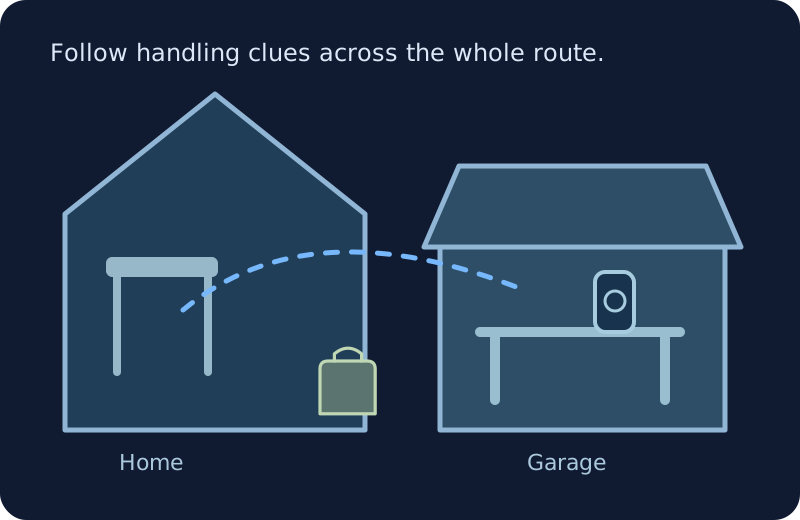
A portable speaker often travels with something else: a bag of groceries, tools or a phone. Reconstruct that carrying route before treating every room as equally likely. A route also makes an unfinished search easier to resume.
This is a practical home-and-garage search, not a Find Now control tutorial. It works from a timeline and observations you already have, and remains useful when no current Bluetooth target is visible.
Completed example
Worked example: a Saturday speaker search in a Phoenix home
Starting information
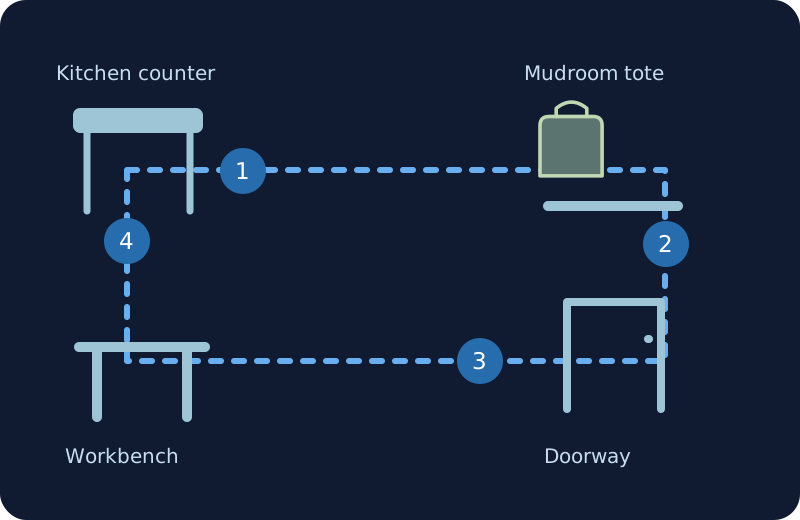
You last listened to your portable speaker at the garage workbench at 10:00 a.m. You then carried it with a tote through the mudroom to the kitchen counter at 10:20 a.m. At 11:00 a.m. it is missing. The tote is on the mudroom bench. You have a plausible target already identified as your speaker. On two passes in the same phone position, existing feedback is stronger at the kitchen counter, weaker at the mudroom bench and absent at the garage doorway. The workbench itself has not been checked.
Useful outcome
Use the route kitchen counter → mudroom bench/tote → garage doorway → workbench. Check the counter and nearby reachable surfaces first, then the tote and bench, then the workbench. Record the garage doorway as no observation, not garage cleared. The repeated kitchen feedback supports priority, but only a physical check can settle where the speaker is.
Illustrative route and qualitative observations, not a captured app output, measured range or successful speaker recovery.
Start with handling events, not a list of every room
Write the last confirmed place you used the speaker and every place you remember putting it down afterward. Separate a remembered handling event from an assumption such as “I usually leave it in the kitchen.” Add the bag, tote or tool carrier that traveled with it.
In the example, both the workbench and kitchen counter have direct handling evidence. The mudroom bench matters because the tote stopped there. That is a stronger starting route than searching bedrooms the speaker never knowingly visited.
Build one route you can repeat and finish
- Name accessible stops using fixed features: kitchen counter, mudroom bench, garage doorway and workbench. Put them in walking order. Record a different floor or locked room as a separate unresolved area rather than silently skipping it.
- At each stop, inspect the surfaces and containers linked to the carrying timeline. Look beside and behind lightweight objects you can normally move. Check your own tote pockets and lining; do not climb shelving or reach into equipment to complete the route.
- Keep a short row for each stop: physical check status, observation time, and target observed or not observed. If your method provides qualitative feedback, write its actual description. Do not invent a number or distance to make the record look more precise.
- If the target is detectable, repeat the same walking order with the same plausible target and comparable phone position. Compare the pattern between passes. Do not mix an observation made inside a room with a later one from its doorway as if they were the same stop.
- Prioritize a room only when its signal evidence repeats or the handling timeline supports it. Mark a negative physical check separately: counter checked, nearby shelf not yet checked. An absent radio observation never changes an unchecked workbench into a cleared room.
- When the route is complete without a find, write the remaining unvisited places or uncertain carrying events. Check with anyone who may have moved your own speaker. If new evidence names another place, extend the route from that fact rather than restarting all checked rooms.
Keep the garage doorway and workbench as separate stops
A doorway is a convenient observation point, but it is not the whole garage. The drawing gives the bench its own physical check so a missing doorway observation does not erase a place named in the timeline.
Use two columns: what you checked and what you observed
A physical-check note might say “tote emptied, speaker not inside.” A signal note might say “target not observed at doorway.” The first narrows a container you actually checked. The second leaves several radio and location possibilities open.
Bluetooth SIG explains that equipment and the environment affect effective range. A wall or other obstacle can change the received signal. Do not turn the route into an exact-distance map or assume that one missing observation proves a room is empty.
When the speaker never appears
Keep using the carrying timeline and physical checks. The route still tells you where to look and what remains unfinished. Unknown power state stays unknown until you find the speaker or obtain other evidence.
If it is physically found, end the location search. Any later charging or connection problem belongs to the exact speaker’s manufacturer instructions. This guide does not ask you to reset, unpair or manipulate a missing speaker to make it appear.
Use Find Now for the detectable part of the route
The current Find Now listing names Bluetooth radar and signal-strength feedback. For your own detectable nearby speaker, that offers a possible clue to add to the route notes. The guide does not promise a particular screen, detection in every room or a direction to the correct shelf.
Keep the named stops even when feedback looks promising. Finding the physical speaker completes the task; a stronger observation only changes which reachable area you check first.
Questions that come up next
Should I start at the strongest reading or the last-use place?
Use the evidence you have. In the worked example, repeated kitchen feedback and a known handling event both justify starting there. With no repeatable feedback, follow the carrying timeline and keep unresolved places on the route.
Does no signal at the garage door rule out the garage?
No. The doorway observation does not inspect the workbench or establish what is detectable deeper inside. Keep those physical stops separate and check only areas you can safely access.
How do I resume after an interruption?
Keep the last completed stop and the next unchecked surface in your note. Resume from there, preserving observation times. Do not treat yesterday’s feedback as a fresh observation just because the route has the same name.
What if someone moved the speaker during the search?
Record that change and ask where they put it. A new handling fact can replace an old route assumption. Keep the earlier notes as earlier observations rather than combining them into a single unchanged pattern.
Will a Bluetooth finder show the speaker through every wall?
This guide makes no such claim. Radio conditions and equipment vary. A local finder is relevant only to a detectable target; the timeline and physical route remain useful when feedback is absent.
For your next nearby search
Add local feedback to a route you can repeat
For your own detectable nearby speaker, consider Find Now’s Bluetooth signal-strength feedback as another clue at the named route stops. Keep physical checks separate from readings; no signal pattern guarantees a location or recovery.
Explore Find Now