Find Now · Device-finding guide
Bluetooth Finder Signal Fluctuates? Compare Positions Before Following It
A stronger reading followed by a weaker one does not prove the device moved. Return to the same positions, keep the phone’s orientation and target consistent, and compare several observations at each stop. Follow a repeatable difference; if the readings overlap or reverse, keep both areas unresolved and use a physical search rather than inventing a distance.

Published by Clara · Publisher
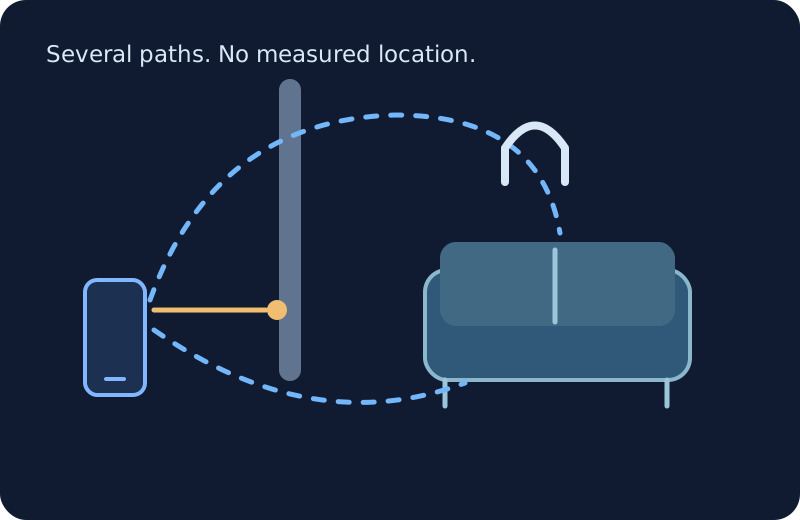
Signal strength is a clue about a received radio signal. Walls, furniture and the path between the objects can change that clue. It is not a tape measure or proof that the strongest-looking entry belongs to your missing item.
Start with a plausible target you have already identified. This guide helps you compare existing readings during a room search, including numeric RSSI if your observation method supplies it. It does not require a particular app screen or a new download.
Completed example
Worked example: couch or doorway in a Chicago apartment?
Starting information
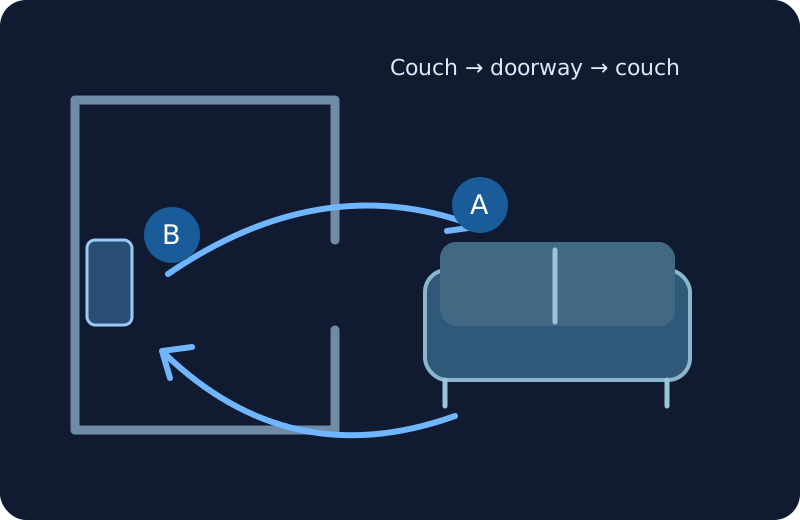
Your own headphones are missing between the living-room couch and the adjoining hallway. You have already narrowed the entry to those headphones. At the couch edge, three recorded RSSI values are −63, −61 and −64 dBm. At the doorway, they are −76, −73 and −75 dBm. On returning to the couch in the same phone position, you record −62, −64 and −63 dBm. Nobody has moved the headphones during these observations.
Useful outcome
Prioritize a physical check of the couch area. Its two sets of readings are consistently stronger than the doorway set. Record the doorway as lower priority, not ruled out. These notes do not locate a cushion or supply a distance in feet; if a later repeat reverses the pattern, reopen the comparison.
Invented readings for a worked reasoning example, not measurements from Find Now or a recovered-device test.
Why strength can change without the device moving
Bluetooth SIG describes radio loss as dependent on both the path and its surroundings. An obstacle can weaken a received signal, while reflection can change the route it takes. A change in your position or the phone’s orientation can therefore make a simple closer-means-stronger story unreliable.
Do not diagnose the exact obstruction from one jump. “The reading changed beside the couch” is an observation. “The headphones must be inside this cushion” is a conclusion that still needs a physical check.
Make a comparison you can repeat
- Choose two reachable stops and name them, such as couch edge and hallway doorway. Use floor features you can return to; do not compare a point halfway down the hall with an unspecified spot near the couch.
- Keep the same plausible target. Hold the phone the same way and keep your position steady at each stop. Record three successive observations using the method you already have. Three is a practical note-taking choice, not a calibrated accuracy threshold.
- Write all three values or strength descriptions beside each stop. Preserve a missing reading as missing rather than entering zero. If the method provides only stronger/weaker descriptions, do not convert them into invented dBm values.
- Return to the first stop and repeat. Favor an area only when the difference remains consistent across the repeated observations. A lone peak among otherwise weak readings is not the same as a repeatable pattern.
- Search the favored area physically, checking reachable seams, surfaces and floor edges. If the sets overlap, alternate in strength or disappear, mark the comparison inconclusive and search from last-use clues instead. Do not keep walking toward whichever isolated reading is highest.
Repeat the stops before widening the search
The illustration shows a return route, not a live tracker. The doorway stays a comparison point while the couch remains a physical search area. Repeating the first stop checks whether your apparent improvement was a one-off.
How to read negative RSSI numbers without turning them into feet
When your existing observation is RSSI in dBm, a less negative value represents more received power: −61 dBm is stronger than −75 dBm. Compare the numbers as signed values, not by the size of their digits.
That ordering does not create a reliable room-distance conversion. Different radio conditions can produce the same received strength. The worked example uses relative observations only; it does not claim that −61 means a particular number of feet away.
What an inconclusive comparison looks like
Suppose the couch notes are −66, −78 and −69, while the doorway notes are −70, −67 and −77. The sets overlap and neither stop has a clean advantage. Write “inconclusive” rather than choosing the single −66 reading as a location.
Return to the last place you handled the headphones and check clothing, the seat and the route you walked. If the candidate’s identity is uncertain, resolve that question before following strength. A stable signal for somebody else’s speaker does not advance your headphone search.
Where Find Now fits after a useful comparison
For a detectable nearby target, Find Now offers a relevant option: its official listing names signal-strength feedback for Bluetooth finding. That fits the local comparison stage, after you have established a plausible target.
Keep the same discipline with any finder: a strength change can help prioritize a physical check, but it does not establish ownership, exact distance or guaranteed recovery. An absent target needs a different decision from a fluctuating one.
Questions that come up next
Does a stronger signal prove I am closer?
No. It shows more received power in that observation, while obstacles and radio paths also matter. Compare repeated stops, then confirm by physically finding the item.
Is −80 stronger than −50 dBm?
No. −50 dBm is the stronger received signal. This numeric ordering does not tell you a dependable distance in feet.
How long should I wait at each stop?
This guide sets no validated timing threshold. Record several actual updates from the observation method you already have. If it does not provide fresh observations, mark the comparison unavailable instead of treating an old value as a new result.
What if the signal disappears during the comparison?
Do not enter zero or conclude the target left the room. Mark it missing, preserve the last observation and use the device-not-detected guide to decide between a local check and a last-use search.
For your next nearby search
Use signal feedback as a local search clue
If your own target remains detectable nearby, consider Find Now’s Bluetooth signal-strength feedback for comparing local search areas. Keep your repeated-position notes and confirm the result with a physical check.
Explore Find Now