Translate Us iPhone Translation Checks
Not All or None? Check the Quantity in an iPhone Translation
Short answer: Not all four excludes four arrivals but does not give the exact number. Its literal possibilities are zero, one, two or three. None of the four fixes the number at zero.
Not all four is different from none of the four. Compare the counts each sentence allows, preserve an unknown number and ask for a headcount when needed.

Published by Clara Publisher
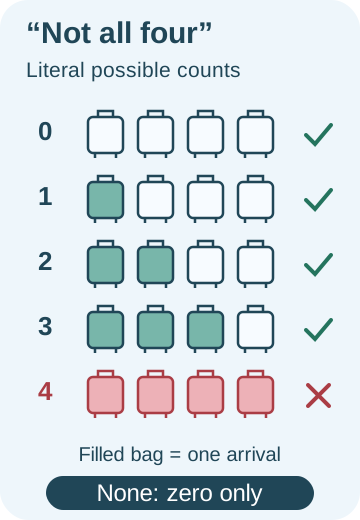
Not all four guests are arriving today does not mean the same thing as None of the four guests are arriving today. The first excludes all four arriving; it leaves the exact number unstated. The second says the number arriving is zero.
For the first sentence’s literal quantity claim, zero, one, two or three arrivals remain possible. Ordinary conversation may suggest that some are coming, but that suggestion is not a dependable headcount. Ask for the number if you need to make a plan rather than turning not all into either nobody or an invented count.
English → Spanish · Illustrative workflow
Not all four does not select zero
Constructed editorial example of quantity scope, not captured app output, a guest forecast or an automatic logic checker.
-
Preserve group, negative and time
English input
Not all four guests are arriving today.
-
Illustrative Spanish wording
Spanish translation
De los cuatro invitados, no todos llegan hoy.
-
Keep the exact count unresolved
Four arrivals is excluded. Zero, one, two or three remain literal possibilities; ask for the count if planning requires it.
Work through the complete four-person example
The group contains exactly four guests. This is a constructed logical comparison of the statements, not a claim about a real booking or an app-produced translation. The Spanish example keeps not all explicit.
Example
- English source
- Not all four guests are arriving today.
- Illustrative Spanish wording
- De los cuatro invitados, no todos llegan hoy.
- Count excluded by the source
- Four arriving today.
- Literal possible arrival counts
- Zero, one, two or three. The exact count is unknown.
- Different source statement
- None of the four guests are arriving today.
- Possible count for the different statement
- Zero only.
- Completed decision
- Do not replace not all with none as though it were an equivalent translation. Zero is one possibility for not all, but the source does not select it.
Keep not attached to what it negates
In not all four, the complete all-four claim is denied. At least one of the four is not arriving today. That does not identify a person, and it does not tell you how many of the others will arrive.
None makes a stronger quantity claim: there is not one arrival from that group. It rules out one, two and three as well as four. Keeping a negative word somewhere in the translation is not enough if the rest of the wording changes that constraint.
A fluent target sentence can still assert the wrong amount. The useful comparison is the set of counts the complete wording permits, rather than whether each English word seems to have a corresponding target word.
Make a quantity record before using the message
Keep the exact group and time period with the negative. The four guests arriving today are the scope of this example; a different group or day would be a different claim.
- Save the full original and exact target sentence. Include the group size and today rather than isolating the phrase not all.
- Record the original’s constraint. For this source, four arrivals is excluded; zero through three remain logically possible. Write exact number unknown.
- Ask what counts the target sentence asserts or rules out. A reader of the target language can explain whether it says not all, none, all or a specific number. Do not guess from the presence of a negative word.
- If the target fixes the number at zero while the source leaves zero through three possible, flag the stronger none claim. Have the full target wording checked rather than swapping one word mechanically.
- If a real plan needs a headcount, ask How many of the four guests are arriving today? Keep the answer as new information, not something extracted from the original alone.
Separate a likely suggestion from a usable number
A speaker who says not all may expect you to understand that some are coming. Context can make that expectation sensible, but this sentence alone still does not give a number. For planning, distinguish what the words establish from what seems likely.
If the sender then confirms two arrivals, a new clear source is Two of the four guests are arriving today. That exact count comes from the confirmation. It cannot be filled into the original merely because two would be convenient.
Similarly, a reply confirming nobody is coming can justify None of the four guests are arriving today as a new message. It is not an automatic equivalent of the first statement.
Translate the whole quantity claim
Translate Us lists text translation on iPhone. For your next everyday quantity message, keep the complete group, negative and time reference together as the text to translate. Compare the result with the quantity record you already made.
A count diagram explains the English distinction; it cannot certify target wording you cannot read. If that wording is unfamiliar, ask a reader of the target language to check the full claim. If the number itself is missing, ask the sender rather than treating a polished result as extra evidence.
Quantity note
Keep the permitted counts visible
This is a completed editorial note, not an app command or an automatic count check.
Original: Not all four guests are arriving today.
Group size: four
Excluded arrival count: four
Literal possible counts: zero, one, two or three
Exact count: unknown
Question for planning: How many of the four guests are arriving today?
Quick check
Before you translate
- Retain the negative, group and time reference together.
- Write what the source rules out and leaves possible.
- Do not turn an unstated count into zero or another number.
- Ask for a headcount when a plan needs one.
FAQ
Frequently asked questions
Does not all guarantee at least one person is arriving?
Not as a literal quantity claim in this example. It guarantees at least one of the four is not arriving. Zero arrivals still fits that constraint, even though a speaker may conversationally suggest a positive number.
Why is none not an equivalent translation?
None selects zero arrivals. Not all four leaves zero, one, two or three possible. The first sentence has not supplied the extra information needed to select zero alone.
Does not all mean exactly three out of four?
No. Three is possible, but so are zero, one and two under the stated literal constraint. Ask for the count rather than treating not all as all except one.
What should I ask when I need to arrange transport?
Ask How many of the four guests are arriving today? If necessary, also ask which guests. Add the confirmed answer to a new message rather than guessing it from the original.
Can the diagram prove that a Spanish or other target sentence is correct?
No. It explains the source constraint. A reader of the target language must still check what the complete target actually asserts, including the group and time reference.
Sources
Useful links
Take it with you
Keep the full quantity message together in your next translation
Translate Us offers text translation on iPhone. Check its current listing and bring your complete everyday sentence, including the group and negative, to the next translation. Compare the result with your quantity note before using an unstated headcount.
Explore Translate Us