Translate Us iPhone Translation Checks
Check Who Did What in an iPhone Translation
Short answer: A voice change is not necessarily an error. Compare the actor, action and recipient: Lina was invited by Omar describes Omar inviting Lina, not the reverse.
A passive sentence can become active without changing the event. Check the actor, action and recipient, and leave an omitted doer unknown.

Published by Clara Publisher
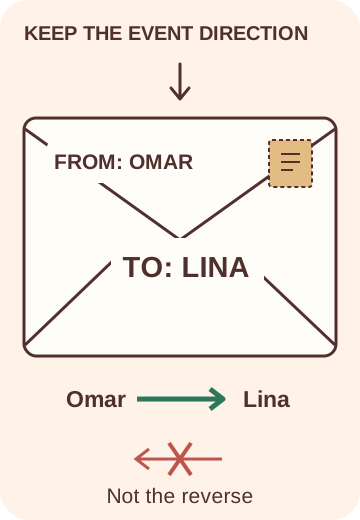
Lina was invited by Omar and Omar invited Lina describe the same invitation. Omar acts; Lina receives the invitation. Lina invited Omar describes a different event even though it contains the same two names.
To check a translation on your iPhone, preserve the original and write a three-part event record: actor, action, recipient. Compare the target against that record rather than assuming the first name in each sentence must do the action. If the original omits the doer, leave that field unknown.
English → Spanish · Illustrative workflow
The voice changes; the invitation direction stays
Constructed editorial translation and event comparison, not captured app output or an automatic role audit.
-
Preserved passive source
English input
Lina was invited by Omar.
-
Illustrative active Spanish wording
Spanish translation
Omar invitó a Lina.
-
Compare roles, not name order
Actor: Omar. Action: invited. Recipient: Lina. Lina invited Omar would reverse the event.
A completed actor, action and recipient check
The English passive below identifies both people. The Spanish example is deliberately written in the active voice to show that a structural change can preserve this event. It is a constructed editorial example, not an app result.
Example
- Preserved English input
- Lina was invited by Omar.
- Actor
- Omar
- Action
- invited
- Recipient
- Lina
- Equivalent active English
- Omar invited Lina.
- Illustrative Spanish wording
- Omar invitó a Lina.
- Different event to reject
- Lina invited Omar.
- Completed decision
- The equivalent English and illustrated Spanish keep Omar as inviter and Lina as invitee. The reversed English assigns the action to Lina and is a different event.
Sentence order and event roles are different things
In this passive sentence, Lina appears first because the sentence focuses on Lina. The by Omar phrase supplies the doer. In the active version, Omar appears first and Lina follows the action. Moving a name does not itself reverse the event.
That does not make active and passive wording interchangeable for every purpose. A writer may deliberately focus on the person affected. First establish whether the event is preserved, then consider whether the changed emphasis fits the message.
Also keep the action specific. Being invited is not the same as accepting or attending. A result that keeps the names in the right direction but changes invited to attended still needs correction.
Make a role record before judging the result
Use the complete sentence rather than extracting the two names. A short event note gives you something concrete to compare, including when the source does not provide an answer.
- Save the original sentence and the exact target wording separately. Do not silently rewrite the saved original.
- Ask who performs the action. In Lina was invited by Omar, the by phrase names Omar. Record Omar as actor.
- Ask what happened and to whom. Record invited as the action and Lina as the recipient. Keep tense and any negative or condition with the event.
- Read the target for the same roles. A changed word order or voice can be legitimate; a changed actor, recipient or action is a different finding.
- If you cannot read the target construction, ask a reader of that language: Who invited whom, and does this describe an invitation rather than attendance? Give that person the complete original and target.
An omitted doer must stay unknown
Now remove the by phrase: Lina was invited. This tells you that Lina received an invitation, but it does not name the inviter. Omar cannot be added simply because Omar was mentioned earlier or seems likely to have organised the event.
A completed note for that shorter source is actor unknown, action invited, recipient Lina. If the identity matters, ask Who invited Lina? Until you have an answer, keep the source’s omission in the translated message.
For the ordinary invitation meaning in this example, Someone invited Lina is a possible English restatement of an unnamed inviter. It still does not establish a particular name. A target-language reader can help choose a natural construction that preserves that omission.
Use the record for your next sentence
Translate Us lists text translation on iPhone. A complete ordinary sentence is a relevant next task once you know the event it expresses. Keep your actor/action/recipient note beside its translation rather than expecting an app to decide whether the roles are correct.
This record is a focused check, not a certificate of the whole translation. It does not settle tone, every word choice or every missing detail. It does let you ask a precise question and avoid calling a legitimate voice change an error, or overlooking a real reversal.
Event note
Keep the event separate from sentence order
This is a completed editorial checking record, not a command to a translator or a special app feature.
Original: Lina was invited by Omar.
Actor: Omar
Action: invited
Recipient: Lina
Equivalent event: Omar invited Lina.
Reject as a different event: Lina invited Omar.
Quick check
Before you translate
- Preserve the complete original and target.
- Identify actor, action and recipient separately.
- Do not infer the doer of an agentless passive.
- Check the event before judging changes in style.
FAQ
Frequently asked questions
Is passive-to-active translation always wrong?
No. Lina was invited by Omar and Omar invited Lina preserve the same invitation. A different emphasis may still matter, but the voice change alone does not prove an event error.
Can matching names hide a reversal?
Yes. Lina invited Omar uses both names but assigns the invitation to Lina. Compare the roles of those names, not just whether they appear.
What if the original never says who acted?
Record actor unknown. For Lina was invited, do not add Omar or another name without evidence. Ask Who invited Lina? if that missing information is needed.
What if I cannot read the target language?
Give a reader of it the complete original and target, then ask who invited whom and whether the action is still an invitation. The event note helps frame that question; it does not verify an unreadable sentence by itself.
Does correct actor direction prove the whole translation is accurate?
No. It checks one important part of meaning. Tense, negatives, conditions, tone and other details can still change, so read the complete message before using it.
Sources
Useful links
Take it with you
Translate the next sentence with its event clear
Translate Us offers text translation on iPhone. Check the current listing, bring one complete everyday sentence to your next translation, and compare its result with the actor, action and recipient you recorded. Keep unknown details unknown.
Explore Translate Us